
Harvesters use hydraulic cylinders to position working components, support header control, and assist with steering and unloading. The arrangement depends on the machine, header, crop, and installed options. Common applications on combine harvesters include header lifting, reel lifting, reel fore-and-aft adjustment, header tilt, steering, and unloading-auger positioning. The correct cylinder must match both the mechanical installation and the hydraulic circuit.
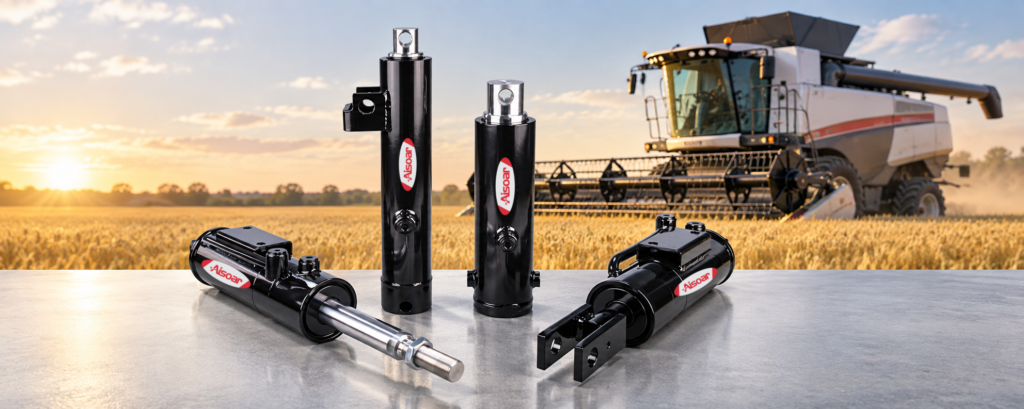
Where Are Hydraulic Cylinders Used on Combine Harvesters?
A combine and its header form an integrated harvesting system, but their cylinders perform different tasks. Some move heavy assemblies through a large range, while others make small adjustments during harvesting.
The following applications provide a useful starting point when identifying a replacement cylinder or developing a new design.
| Cylinder application | Typical installation area | Main function |
|---|---|---|
| Header lift | Between the machine frame and feederhouse | Raises and lowers the header assembly |
| Reel lift | At the header’s reel support arms | Adjusts reel height |
| Reel fore-and-aft adjustment | Along the reel support arms | Moves the reel forward and backward |
| Header tilt | At the feederhouse or header adapter | Adjusts the header’s lateral or cutting angle |
| Cutterbar flotation | Within selected flexible-header support mechanisms | Adjusts cutterbar support and ground pressure |
| Steering | At the steering axle and linkage | Changes wheel steering angle |
| Unloading-auger swing | Near the unloading tube pivot mechanism | Moves the unloading tube between positions |
These functions are not fitted to every machine. A grain header with a reel, for example, has different requirements from a corn header.